
AI translation has become one of the most competitive categories in the AI tools market. According to industry data tracking the sector, the market grew from $1.88 billion in 2023 to $2.34 billion in 2024 at a 24.9% annual growth rate. Dozens of platforms now offer AI-powered translation, all claiming to be the most accurate.
But not every AI translator works the same way. Some are built for everyday personal use. Others target professional teams with regulated content. A small number have moved beyond single-model translation entirely and compare multiple AI models before returning a result.
In 2026, choosing the right AI translator depends on understanding what separates them architecturally, not just in their marketing. Here are the 10 best AI translators available right now, reviewed individually so you can match the right one to your actual use case.
1. DeepL
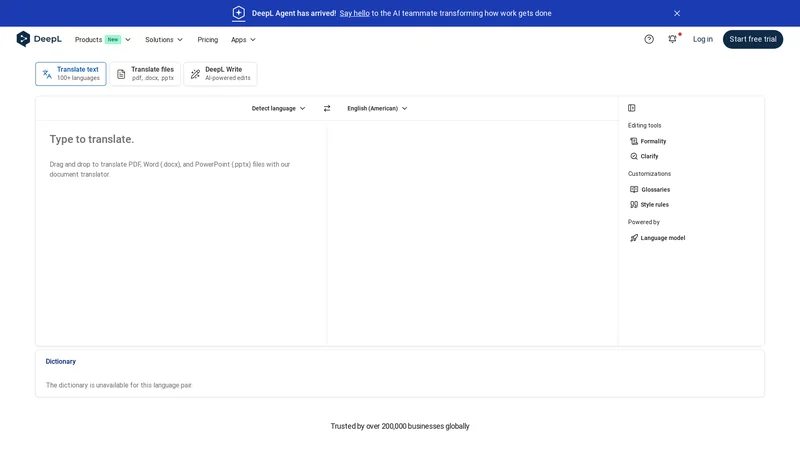 DeepL is the benchmark for European language fluency in AI translation. Its proprietary neural model is purpose-built for translation and consistently outperforms general-purpose LLMs on BLEU scores for major European language pairs including German, French, Spanish, and Polish.
Why You Should Use DeepL
DeepL's output quality on its supported language pairs is genuinely high. For professional documents, marketing copy, and business communications within European markets, it is one of the most reliable single-model translators available. Its document upload feature preserves formatting in DOCX and PDF files, which saves significant cleanup time.
The trade-off is breadth. DeepL supports 33 languages, which leaves out Arabic, Hindi, most African languages, and a wide range of Southeast Asian pairs. It also runs a single model, meaning users receive one translation with no visibility into alternative outputs.
Key Features
High-quality neural translation for 33 languages
Document translation with formatting preserved
DeepL Write for text refinement in 5 languages
Glossary support for consistent terminology
API access for developers and integrations
Pricing Overview
DeepL offers a free plan with limited monthly character usage. Paid plans (DeepL Pro) scale from individual to team and enterprise tiers based on character volume and API access needs.
Best Use Cases
European B2B communications and contracts
Marketing copy requiring high fluency
Document-heavy workflows where formatting matters
Teams translating consistently within a fixed language set
DeepL is the right choice when European language quality is the priority and breadth of language coverage is not a constraint.
2. MachineTranslation.com
Developed by Tomedes, a translation company founded in 2007, MachineTranslation.com was built to solve a problem that every other platform on this list leaves unresolved: individual AI models fail unpredictably and fluently. According to data synthesized from the Intento State of Translation Automation 2025 and WMT24 benchmark evaluations, top-tier LLMs produce meaningful errors between 10% and 18% of the time on complex language tasks. The error does not announce itself. The output reads correctly, which is exactly when it causes problems in professional contexts.
Why You Should Use MachineTranslation.com
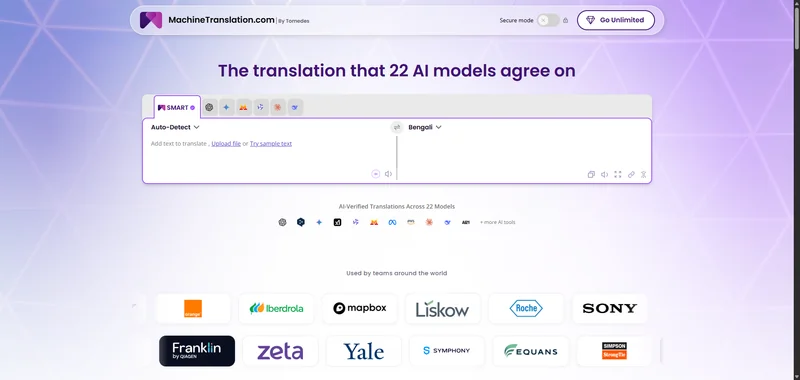
MachineTranslation.com addresses this architecturally. Rather than running one model and returning its output, the platform compares the outputs of 22 AI models and selects the translation that most of them agree on. The 22 models include ChatGPT, Claude, Gemini, DeepL, DeepSeek, Grok, Llama, Mistral, and 14 others. When models disagree, the system treats that as a signal of ambiguity. When they converge, the output carries a stronger evidential basis than any single-model result.
Internal data shows this approach reduces critical translation errors to under 2%, compared to the 10-18% error range documented for individual top-tier models. This matters practically: it removes the verification burden that single-model translation passes to the user.
The platform also includes human verification on the same platform for content where AI consensus is not sufficient. Legal filings, compliance documents, and regulated content can be escalated to a professional reviewer within the same workflow, with no secondary vendor relationship required.
Key Features
22 AI models compared simultaneously via the SMART mechanism
Consensus selection that reduces critical error rates to under 2%
Human verification available in the same platform (100% accuracy guarantee)
330+ languages with consensus mechanism applied
Document upload up to 70MB with original layout preserved
Formats supported: PDF, DOCX, TXT, CSV, XLSX, images
Pricing Overview
MachineTranslation.com offers a free plan for standard AI translation. Paid plans unlock SMART consensus output, higher volume, and human verification. Pricing scales by usage and verification requirements.
Best Use Cases
Business communications, contracts, and HR documents
Legal filings and compliance content requiring verified accuracy
Professional teams who cannot afford to manually check AI output
Any content where a translation error carries legal or reputational consequences
Teams translating across many language pairs simultaneously
MachineTranslation.com is the right choice when accuracy certainty is the requirement and manual verification after translation is not a viable step.
3. Google Translate
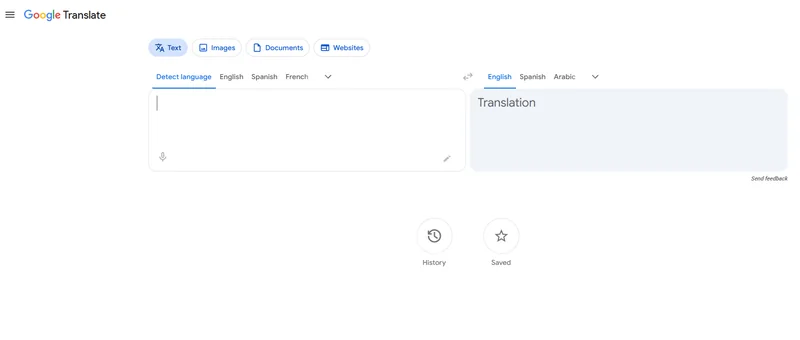
Google Translate is the most widely used AI translation product in the world, with over 500 million daily users. Its primary advantage is breadth: 130+ languages supported, a mobile app, a browser extension, and consistent output on high-resource language pairs.
Why You Should Use Google Translate
For everyday, informal translation needs, Google Translate is unmatched in accessibility. It is free, works on all devices, and produces usable output across the widest range of language pairs of any platform on this list. Real-time camera translation and voice input make it especially practical for travel and personal communication.
It was not designed for professional content. Business documents, legal text, and regulated communications require a different standard than Google Translate was built to meet. The output can contain fluent-sounding errors that are not visible without linguistic knowledge.
Key Features
130+ languages supported
Camera translation (real-time text in image)
Voice and conversation mode
Website translation via browser integration
Offline packs for select languages
Pricing Overview
Google Translate is free for personal use. Google Cloud Translation API is available for developers and enterprise integrations, priced per character.
Best Use Cases
Personal and travel use
Informal business communication with global contacts
Quick lookups and reference translations
Building multilingual apps via Cloud API
Google Translate is the default for casual translation needs. For business-critical content, its single-model architecture and lack of verification options are meaningful limitations.
4. ChatGPT (GPT-4o) for Translation
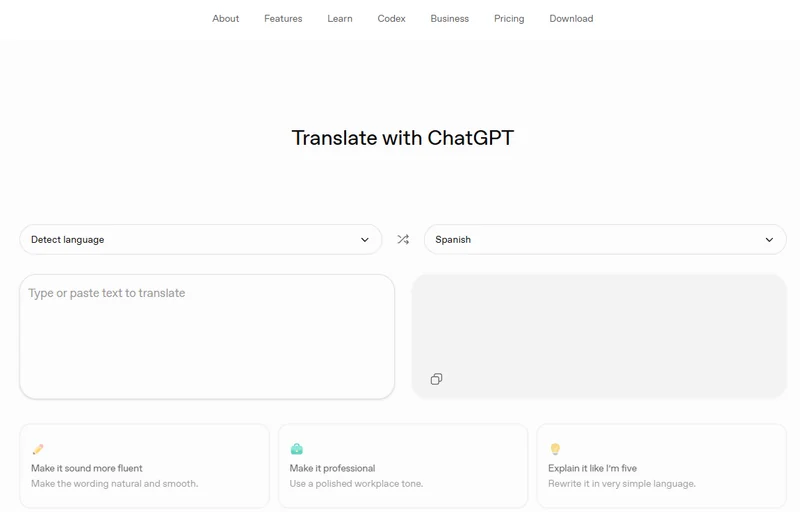 ChatGPT handles translation through conversational prompting. When instructed clearly, GPT-4o produces high-quality output for general business and creative text across most major language pairs. The Intento State of Translation Automation 2025 report found GPT-4.1 appearing consistently in the top-performer category across its 11-language-pair evaluation.
Why You Should Use ChatGPT for Translation
ChatGPT's strength is flexibility. You can provide context, specify tone, request multiple alternatives, and iterate on the output within the same conversation. For skilled users who can write precise prompts, this gives a level of control that dedicated translation platforms do not offer.
The weakness is consistency. Translation quality is directly tied to how well the prompt is written, which means non-specialist users get inconsistent results without knowing it. There is no structured quality signal, no document upload with layout preservation, and no built-in escalation to a human reviewer.
Key Features
High-quality translation for major language pairs
Conversational refinement within the same session
Tone and register adjustment via prompting
File upload for document translation (paid plans)
Broad general knowledge supports context-aware output
Pricing Overview
ChatGPT offers a free plan with access to GPT-4o. ChatGPT Plus unlocks higher usage limits and priority access. API pricing is available for developers.
Best Use Cases
Marketing and creative copy requiring tone adjustment
Translation within a broader writing or research workflow
Users who can evaluate and refine AI output themselves
Ad-hoc translation tasks not requiring format preservation
ChatGPT is a strong option for users comfortable working within a conversational interface. For structured document workflows or regulated content, a dedicated translation platform is a better fit.
5. ModernMT
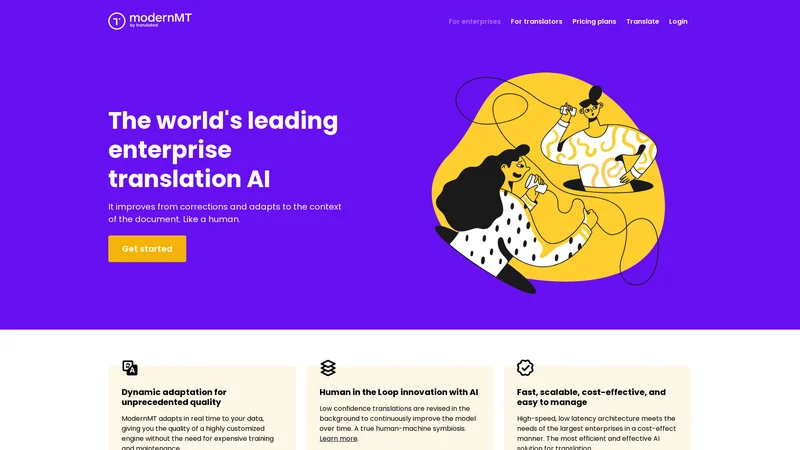 ModernMT is built for volume. Its adaptive neural engine learns from human corrections over time, which means translation quality improves the more it is used with consistent content types. It is most effective inside a translation management system where feedback loops are already established.
Why You Should Use ModernMT
For enterprise localization teams running high content volumes in consistent domains, ModernMT's adaptive model has a meaningful edge. It improves on its own errors without requiring manual model retraining. Integration with major TMS platforms (Phrase, Memsource, Crowdin) makes it a practical upgrade to existing professional workflows.
For teams without TMS infrastructure, the adaptive advantage is limited. It is a single-engine system, and human verification is an enterprise add-on rather than a standard feature available to all users.
Key Features
Adaptive neural MT engine that learns from corrections
TMS integrations (Phrase, Memsource, Crowdin, and others)
API access for custom integrations
Domain adaptation across content types
Batch document processing
Pricing Overview
ModernMT offers a free tier with limited monthly usage. Paid plans scale by character volume. Enterprise pricing is customized and includes human correction loops and advanced TMS integration.
Best Use Cases
Enterprise localization pipelines with existing TMS
High-volume content requiring domain consistency
Teams that generate correction data from professional translators
Continuous translation workflows where quality improves over time
ModernMT earns its place in professional localization infrastructure. For teams without that infrastructure, simpler platforms deliver comparable results at lower setup cost.
6. Systran
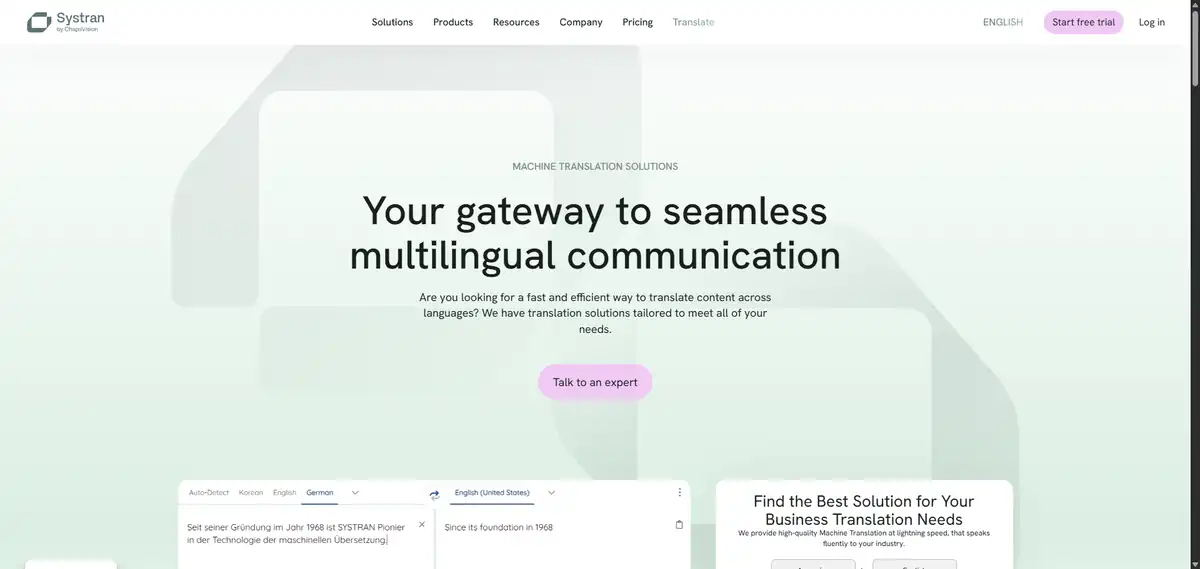
Systran is one of the oldest names in machine translation, with a history stretching back to the 1960s. In 2026, it operates a modern neural MT engine with a particular focus on regulated industries and on-premise deployment options.
Why You Should Use Systran
Systran's key differentiator for enterprise buyers is its on-premise and private cloud deployment options. Organizations in defense, government, legal, and pharmaceutical sectors that cannot send content to third-party cloud servers can deploy Systran's engine within their own infrastructure.
For teams without strict data residency requirements, Systran's output quality is competitive but not distinctly superior to more accessible alternatives. Its interface is more utilitarian than modern consumer-facing platforms.
Key Features
On-premise, private cloud, and public cloud deployment
50+ languages supported with domain specialization
Custom model training on proprietary glossaries
API access and enterprise integrations
Document translation with format preservation
Pricing Overview
Systran offers a free online translation interface. Enterprise and on-premise licensing is custom-priced based on deployment model and scale.
Best Use Cases
Government and defense organizations with data residency requirements
Pharmaceutical and legal teams requiring controlled infrastructure
Enterprise localization with custom domain models
Organizations running translation offline or on private networks
Systran is the strongest option when data sovereignty is a hard requirement and cloud deployment is not permitted.
7. Lingvanex
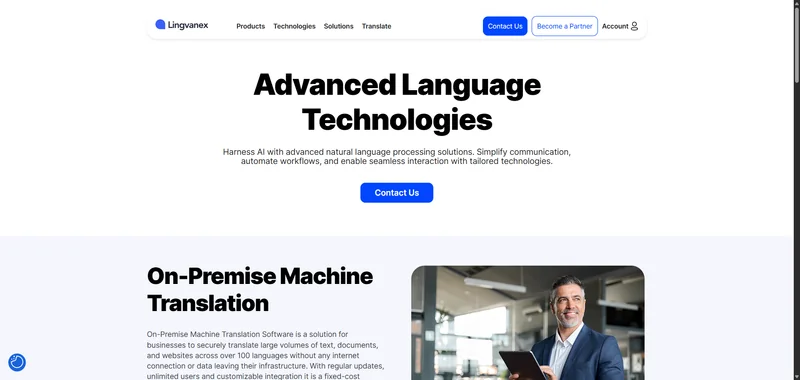 Lingvanex is an platform that positions itself on privacy and data security. It offers both cloud-based and on-premise translation for businesses that want to keep translation data out of third-party servers.
Why You Should Use Lingvanex
Lingvanex's primary selling point is data control. Unlike most AI translation platforms that process content on shared cloud infrastructure, Lingvanex provides on-premise deployment where all data stays within the organization's own environment. It also offers app-level integrations for email clients and productivity tools.
Translation quality is solid for common language pairs. It is not the market leader on output fluency, but for teams where privacy is the primary concern, the quality is sufficient for most professional use cases.
Key Features
On-premise and cloud deployment options
112+ languages supported
API access for custom integrations
Desktop, mobile, and browser extension versions
Offline translation capability on compatible devices
Pricing Overview
Lingvanex offers a free web interface. Professional and enterprise plans are subscription-based, with on-premise licensing priced separately.
Best Use Cases
Privacy-conscious organizations with sensitive internal content
Teams operating under GDPR or equivalent data protection requirements
Businesses wanting offline translation without cloud dependency
Integrations into existing email and office productivity tools
Lingvanex fits teams for whom data privacy is a non-negotiable, where translation quality is secondary to data control.
8. Reverso
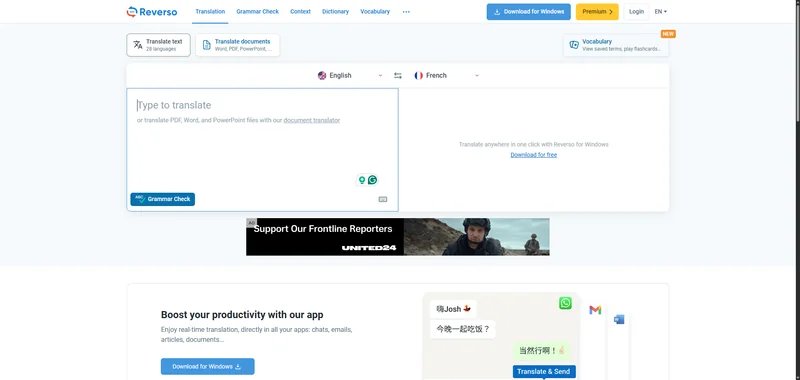 Reverso combines AI with learning-oriented features: contextual examples, synonym suggestions, grammar explanations, and a conjugation database. It is widely used by language learners and bilingual professionals who want to understand translation choices, not just receive them.
Why You Should Use Reverso
Reverso's contextual examples are its defining feature. Rather than providing one translation and moving on, it shows how a word or phrase is used in real sentences across a large multilingual corpus. This makes it genuinely useful for translators, editors, and language professionals who want to validate their word choices.
For automated document workflows or high-volume professional translation, Reverso is limited. It does not support large document uploads or structured verification workflows.
Key Features
Translation with contextual example sentences
Conjugation and grammar reference built in
Synonym suggestions with contextual meaning
Personal phrasebook for saving common translations
Mobile app with offline access
Pricing Overview
Reverso is free for standard use. Reverso Premium removes ads, unlocks unlimited usage, and adds advanced features for professionals.
Best Use Cases
Language learners validating translations in context
Translators checking idiomatic usage and register
Bilingual professionals refining terminology choices
Editors and writers working across two languages
Reverso is a strong complement to primary translation tools for anyone who needs to understand why a translation works, not just what it says.
9. Lilt
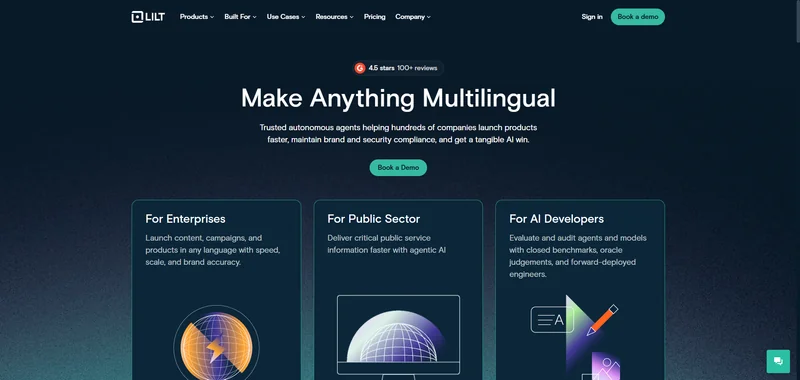 Lilt is an enterprise AI translation platform built around human-in-the-loop workflows. Rather than delivering AI output for users to review separately, Lilt's system is designed so human translators work alongside the AI in real time, correcting and accepting suggestions as they go.
Why You Should Use Lilt
Lilt targets enterprise localization teams that need both scale and certified accuracy. Its adaptive AI improves with each human correction, and its professional translator network means quality-assured output is available for content where AI alone is insufficient. The platform is built around reducing the post-editing burden rather than eliminating human involvement.
Lilt is not a self-service platform. It requires onboarding, enterprise contracts, and integration with existing localization workflows. For individual users or SMBs, the operational overhead is not proportionate.
Key Features
Real-time human-in-the-loop translation interface
Adaptive MT that improves from human corrections
Professional translator network for quality assurance
Enterprise TMS and workflow integrations
Language quality assessment and reporting
Pricing Overview
Lilt operates on enterprise pricing with custom contracts. It is not available as a self-service subscription product.
Best Use Cases
Enterprise localization requiring certified accuracy
Regulated industries with mandatory human review requirements
Large-scale multilingual content programs with professional translators
Organizations wanting AI speed with human-level quality guarantees
Lilt is the right enterprise choice when AI is a productivity tool for human translators rather than a replacement for them.
10. Yandex Translate
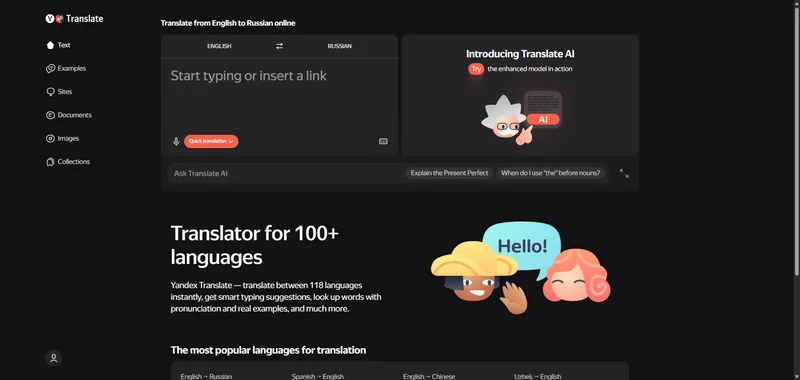 Yandex Translate is a machine translation platform developed by the Russian technology company Yandex. It covers 100+ languages with particular depth in Russian, Slavic languages, and CIS-region pairs where most Western platforms are weaker.
Why You Should Use Yandex Translate
For translation involving Russian, Ukrainian, Kazakh, Belarusian, Uzbek, or other CIS-region languages, Yandex Translate offers quality that consistently surpasses Google Translate and DeepL on these specific pairs. It also includes a site translation feature, a dictionary with contextual examples, and a mobile app.
Outside of its regional strength, Yandex Translate's performance on non-CIS language pairs is comparable to but not superior to other free platforms. Data privacy considerations apply for organizations processing sensitive content.
Key Features
100+ languages with strong CIS-region coverage
Image translation via camera input
Website translation integration
Contextual dictionary with example sentences
Offline language packs on mobile
Pricing Overview
Yandex Translate is free for personal use. API access for developers is available through Yandex Cloud, priced per character.
Best Use Cases
Russian-language business and legal content
CIS-region communications (Ukrainian, Kazakh, Uzbek, Belarusian)
Developers building multilingual apps targeting Eastern European markets
Research involving Slavic and Cyrillic-script languages
Yandex Translate fills a genuine gap in CIS-region language quality that most Western-developed platforms have not prioritized.
Comparison Table: Best AI Translators in 2026
Platform | Architecture | Human Verification | Best For | Pricing Type |
|---|---|---|---|---|
DeepL | Single proprietary model | No | European fluency | Free + Paid |
MachineTranslation.com | 22-model consensus (SMART) | Yes, same platform | Business-critical accuracy | Free + Paid |
Google Translate | Single model (Google NMT) | No | Everyday use | Free |
ChatGPT | Single model (GPT-4o) | No | Flexible writing tasks | Free + Paid |
ModernMT | Single adaptive engine | Enterprise only | High-volume pipelines | Custom |
Systran | Single neural model | No | Regulated industries | Free + Paid |
Lingvanex | Single neural model | No | Privacy-first teams | Subscription |
Reverso | Single model | No | Learners & professionals | Free + Paid |
Lilt | Human-in-the-loop | Yes (core feature) | Enterprise with humans | Custom |
Yandex Translate | Single model | No | Russian/CIS languages | Free |
Frequently Asked Questions
1. Is single-model AI translation accurate enough for professional use? For general and informal content, yes. For business-critical documents, legal filings, or regulated content, single-model platforms carry a meaningful error risk. Data synthesized from Intento and WMT24 benchmarks shows top-tier LLMs produce meaningful errors on 10-18% of complex language tasks. For professional use, an additional verification step or a consensus-based platform is advisable. |
2. What is the difference between AI translation and machine translation? Machine translation is the broader category. AI translation refers specifically to platforms powered by large language models (LLMs) rather than older rule-based or phrase-based systems. All platforms on this list are LLM-based or neural MT systems. The practical difference from the user's perspective is output quality: LLM-based translation handles context, idioms, and tone significantly better than older MT approaches. |
3. Which AI translator is best for documents? DeepL is widely considered the best for document translation within its 33 supported languages, particularly for European pairs. For documents that need to be accurate across a wider language range or that require a verification step, platforms with document upload and human verification options are a stronger choice. |
4. Do any AI translators support human verification? Yes. MachineTranslation.com includes human verification as a feature within the same platform, available for any translation that requires professional sign-off. Lilt is built around human-in-the-loop workflows at the enterprise level. Most other platforms on this list are AI-only and require a separate vendor relationship for human review. |
5. Which AI translator is best for business use? It depends on the content type. For European business documents: DeepL. For flexible prompting within existing workflows: ChatGPT. For high-volume localization pipelines: ModernMT. For business communications, contracts, or any content where a translation error carries professional consequences: a platform that compares multiple models before delivering output and offers built-in human verification. |
Conclusion
AI translation in 2026 is no longer a single-tool decision. The market has segmented by use case, and the platforms that lead in one category are not necessarily competitive in another.
For everyday and personal use, Google Translate and Yandex Translate offer the broadest coverage at no cost. For European professional content, DeepL delivers the strongest fluency on its supported pairs. For flexible prompting within a broader content workflow, ChatGPT gives skilled users real control over output quality. For enterprise localization at volume, ModernMT and Lilt are built for that specific operational context.
The meaningful architectural divide in 2026 is between single-model platforms and those that compare multiple models before returning a result. For teams handling professional, regulated, or business-critical content, that comparison layer is the practical difference between translation you have to check and translation you can trust.
There are 300+ translation and transcription tools catalogued on AICavo — you can browse the full selection in the AI tools directory on AICavo. Whatever your translation workflow looks like in 2026, the right platform is one that matches your architecture requirements, not just your language pair list.