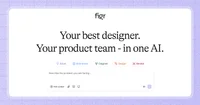
Figr.design is an AI design agent that generates production-ready UX by using product context, industry benchmarks, user feedback, product flows, and existing design systems.
Figr.design is an AI-powered design agent built to generate production-ready UX that is grounded in your actual product context. It ingests your industry benchmarks, user feedback, product flows, and design systems to create interfaces and flows that align with real-world patterns and constraints. The primary purpose of Figr.design is to replace guesswork and manual iteration with data-informed, context-aware UX design that teams can ship with confidence.
The platform allows you to provide detailed inputs—such as product requirements, user journeys, component libraries, and existing screens—and then produces high-fidelity UX proposals that respect your design tokens, layout rules, and interaction patterns. It references real app examples and established UX conventions to ensure outputs feel familiar and usable to end users. Figr.design also supports rapid iteration: you can refine flows, copy, and layouts through structured prompts while preserving consistency with your design system. By grounding every recommendation in both your product and industry standards, it reduces the risk of misaligned designs and endless revision cycles.
Please sign in to comment
💬 No comments yet
Be the first to share your thoughts!
Explore 326+ top alternatives to Figr.design

Autodesk Fusion is an integrated 3D CAD, modeling, simulation, and manufacturing platform for designing, engineering, and producing mechanical, industrial, and electronic products.
MockAPI Dog provides free, no-signup mock REST APIs and LLM streaming endpoints for testing and developing AI integrations and applications.

ScrapeStorm is an AI-powered visual web scraping tool that extracts structured data from websites without coding and runs on all major operating systems.

Feedbuck AI is a platform that collects, analyzes, and summarizes user feedback from multiple channels to provide structured insights for product and customer experience teams.