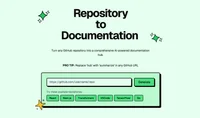
Generate structured, readable documentation from any GitHub repository by automatically analyzing code, files, and project structure to produce summaries, overviews, and reference materials.
GitSummarize is a documentation automation tool that converts any public GitHub repository into structured, readable documentation in seconds. Its primary purpose is to help developers, teams, and technical writers quickly understand unfamiliar codebases and keep project documentation aligned with the current state of the repository. By analyzing the repository’s structure, source files, and metadata, GitSummarize produces concise, high-level overviews that are easy to share and maintain over time.
Under the hood, GitSummarize inspects directories, key source files, and configuration files to generate summaries that explain the project’s purpose, architecture, and main components. It can highlight important modules, core functionalities, and relationships between files, helping users grasp how the codebase is organized without reading every line of code. The tool is designed to work with a wide range of languages and frameworks commonly hosted on GitHub, making it suitable for polyglot environments. Its output is formatted to be readable in documentation platforms, wikis, or README files, reducing the manual effort required to write and update technical documentation.
Please sign in to comment
💬 No comments yet
Be the first to share your thoughts!
Explore 1000+ top alternatives to GitSummarize

Pluginport IO is a digital agency that designs, develops, and deploys custom AI and web applications for clients using a multidisciplinary product-focused team.
Tencentcloud is a cloud computing platform that provides scalable infrastructure, AI services, and integrated tools for building, deploying, and managing applications across Tencent’s digital ecosystem.

NeuroBlock is an AI laboratory that optimizes enterprise AI models using curated datasets, provides private on-premise integrations, builds lead generation tools, and maintains an OpenData platform.