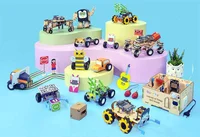
STEMpedia provides an educational platform offering AI, STEM, and robotics curricula, tools, and learning resources to help students develop practical technology and engineering skills.
STEMpedia is an integrated learning platform designed to help schools, educators, and students build practical skills in AI, STEM, and robotics. It combines hardware, software, and curriculum resources to enable hands-on learning aligned with 21st-century competencies. The primary purpose of STEMpedia is to make complex technologies accessible and teachable in structured, classroom-ready formats.
The platform offers modular robotics kits, electronic components, and sensors that can be programmed using user-friendly visual coding interfaces and text-based languages. It includes AI and machine learning learning paths, allowing students to experiment with image recognition, speech processing, and data-driven projects in a guided environment. Ready-made lesson plans, projects, and assessments are mapped to age groups and learning outcomes, helping teachers implement STEM programs without needing deep technical expertise. Cloud-based resources, tutorials, and documentation support both in-person and remote instruction, while integrations with common classroom tools simplify deployment.
Please sign in to comment
💬 No comments yet
Be the first to share your thoughts!
Explore 309+ top alternatives to STEMpedia

World Labs provides spatial intelligence models that perceive, generate, and interact with 3D environments for applications such as robotics, simulation, mapping, and virtual reality.

Agilityrobotics provides a cloud-based automation platform for configuring, deploying, and managing robots and equipment across logistics and manufacturing workflows.
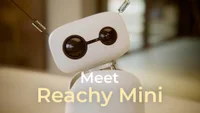
Reachy Mini is a compact, open-source humanoid robot platform for research and education, enabling manipulation, vision-based interaction, and reinforcement learning experiments.