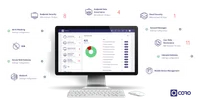
Sonicwall is a cybersecurity platform that provides firewalls, threat detection, secure remote access, and network security management for enterprises, service providers, and managed security providers.
SonicWall is a comprehensive cybersecurity platform designed to protect organizations from advanced threats across networks, endpoints, and cloud environments. It provides a unified security architecture that helps managed service providers (MSPs), enterprises, and SMBs secure distributed workforces, hybrid infrastructures, and critical applications. The platform focuses on delivering consistent, policy-driven protection while simplifying security operations and management.
Key capabilities include next-generation firewalls with deep packet inspection, intrusion prevention, and application control, as well as secure SD-WAN for resilient, optimized connectivity. SonicWall’s Capture Advanced Threat Protection (ATP) uses cloud-based, multi-engine sandboxing to detect and block zero-day and encrypted threats in real time. The platform also offers secure remote access via SSL VPN and Zero Trust Network Access (ZTNA), along with email security, endpoint protection, and wireless security solutions. Centralized management and analytics through SonicWall Network Security Manager (NSM) enable unified policy control, automated reporting, and detailed threat visibility across multiple tenants and locations.
Please sign in to comment
💬 No comments yet
Be the first to share your thoughts!
Explore 512+ top alternatives to Sonicwall

Paloaltonetworks provides cybersecurity platforms and services that secure networks, cloud workloads, and hybrid workforces using firewalls, threat intelligence, access control, and security operations tools.

Reliaquest is a security operations platform that unifies threat detection, investigation, and automated response to reduce manual Tier 1 and Tier 2 analyst work.

Forcepoint is a cybersecurity platform that monitors, classifies, and controls data usage across cloud, endpoint, and network environments to prevent unauthorized access, exfiltration, and loss.

Fortinet provides a cybersecurity platform that integrates firewalls, secure networking, endpoint protection, and cloud security to protect enterprise networks, applications, and data across distributed environments.