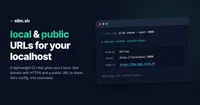
Map local development servers to readable .test domains with automatic HTTPS, SSL certificates, WebSocket and HMR support, path-based routing, and optional public tunneling via slim.show.
Slim is a command-line tool that provides clean, human-readable `.test` domains for local development, complete with automatic HTTPS. It acts as a lightweight, zero-config reverse proxy that maps localhost ports to custom domain names, simplifying access to multiple services and applications during development. Designed for macOS and Linux, Slim focuses on making local environments behave more like production, especially with respect to SSL and domain-based routing.
Slim automatically provisions and manages local SSL certificates, so developers can work over HTTPS without manual certificate creation or browser warnings. It supports WebSockets and hot module reloading (HMR), ensuring that modern frontend tooling and real-time backends function correctly through its proxy. Path-based routing lets you direct different URL paths to different local services, useful for microservices or API/backend separation. In addition, Slim provides public URL tunnels via `slim.show`, enabling secure sharing of local applications with teammates, stakeholders, or external services for testing and demos.
Please sign in to comment
💬 No comments yet
Be the first to share your thoughts!
Explore 24+ top alternatives to Slim

Provide dedicated, high-performance mobile proxy connections across multiple countries and carriers, enabling reliable IP rotation, session management, and geo-specific access for web scraping, automation, and data collection.

Incogniton is an anti-detect browser that lets users manage multiple isolated browser profiles and accounts while masking device fingerprints to maintain online anonymity.
Scrapeless provides a full-stack web scraping toolkit with APIs, headless browser, captcha solving, and proxies to reliably extract and collect structured data from websites.