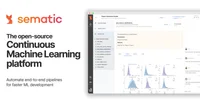
Sematic is an open-source platform that orchestrates, executes, and manages end-to-end machine learning and AI workflows, including pipelines, dependencies, and infrastructure integration.
Sematic is an open-source orchestration platform designed to help teams build, run, and manage end-to-end machine learning and AI pipelines. It focuses on making complex workflows reproducible, observable, and easier to maintain across development and production environments. By providing a unified framework for defining, executing, and tracking pipelines, Sematic reduces the operational overhead of ML and AI systems.
The platform allows users to define pipelines in Python as composable functions, enabling clear structure, type safety, and reusability. Sematic provides automatic tracking of pipeline runs, inputs, outputs, and intermediate artifacts, giving teams full lineage and reproducibility for experiments and production jobs. It integrates with common compute backends and infrastructure, allowing pipelines to scale from local development to distributed execution without major code changes. A web-based UI offers visibility into pipeline graphs, execution status, logs, and metrics, making debugging and monitoring more efficient.
Please sign in to comment
💬 No comments yet
Be the first to share your thoughts!
Explore 1000+ top alternatives to Sematic
Tencentcloud is a cloud computing platform that provides scalable infrastructure, AI services, and integrated tools for building, deploying, and managing applications across Tencent’s digital ecosystem.

Pluginport IO is a digital agency that designs, develops, and deploys custom AI and web applications for clients using a multidisciplinary product-focused team.