
Pytorch is a deep learning framework that provides tensor computation, automatic differentiation, and tools for building, training, and deploying neural network models in Python and C++.
PyTorch is an open-source deep learning framework designed for building, training, and deploying machine learning models with a focus on flexibility and speed. Developed originally by Meta AI and now governed by the PyTorch Foundation, it provides a Pythonic interface that closely integrates with the scientific computing ecosystem. Its primary purpose is to support research and production workflows in computer vision, natural language processing, reinforcement learning, and other AI domains through an intuitive, imperative programming style.
Key features of PyTorch include dynamic computation graphs (define-by-run), which make debugging and model experimentation straightforward, and a comprehensive tensor library with GPU acceleration via CUDA. It offers a rich ecosystem of domain-specific libraries, such as TorchVision, TorchText, TorchAudio, and TorchRL, and supports distributed training for scaling models across multiple GPUs and nodes. PyTorch integrates tightly with ONNX for model export and interoperability, and provides TorchScript and TorchServe for model optimization and production deployment. Its autograd engine enables automatic differentiation for complex neural network architectures.
Please sign in to comment
💬 No comments yet
Be the first to share your thoughts!
Explore 421+ top alternatives to Pytorch
Tencentcloud is a cloud computing platform that provides scalable infrastructure, AI services, and integrated tools for building, deploying, and managing applications across Tencent’s digital ecosystem.

Sourceforge is a software discovery and distribution platform that provides business software reviews, comparisons, directories, and free downloads and hosting for open source projects.
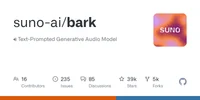
Suno AI Bark is a text-to-audio generative model that synthesizes speech, music, and other sounds from written prompts in multiple languages and styles.